

Posted by Biomatstores.com on 31st Jul 2026
Therapy Mat: The Complete Buyer's Guide to Choosing the Right Therapy Mat in 2026
If you've been searching for a therapy mat, you've probably noticed something confusing.
Some therapy mats use heat. Others use massage. Some incorporate far infrared technology or red light therapy. Others are little more than thick foam exercise mats marketed for stretching or physical therapy.
They all share the same name—but they are completely different products designed for different goals.
That's why buying a therapy mat can feel overwhelming.
One website recommends a massage mat. Another recommends a PEMF mat. Another tells you to buy an acupressure mat. Yet another insists that an infrared therapy mat is the best option.
Who's right?
The truth is that there isn't one "best" therapy mat.
There is only the therapy mat that best fits your needs.
This guide was created to help you understand the different categories of therapy mats, how they work, who they're designed for, and what to consider before investing in one.
Whether you're looking for a therapy mat for relaxation, recovery, stretching, heat therapy, massage, or everyday wellness, this guide will help you make a more informed decision.
What Is a Therapy Mat?
A therapy mat is a broad term used to describe mats designed to support physical comfort, relaxation, exercise, or wellness. Unlike ordinary yoga mats or exercise mats, therapy mats typically incorporate features intended to provide a specific experience beyond simple cushioning.
Depending on the design, a therapy mat may include:
- Gentle heat
- Massage mechanisms
- Far infrared technology
- PEMF (Pulsed Electromagnetic Field) technology
- Red light therapy
- Acupressure stimulation
- Extra support for stretching or rehabilitation exercises
Not every therapy mat includes all of these features, and many focus on only one.
That is why understanding the different categories is far more important than simply comparing prices.
Why Are Therapy Mats So Popular?
Over the past decade, more people have begun creating wellness spaces in their own homes. Instead of scheduling appointments every time they want to relax or recover from a long day, many people now invest in products that allow them to build healthy routines at home.
A therapy mat fits naturally into that trend.
Depending on the model, a therapy mat can become part of a daily routine while reading, watching television, meditating, stretching, or simply taking time to unwind.
Many people also appreciate that therapy mats generally require very little setup. Unlike larger wellness equipment, many can simply be unrolled, plugged in (if applicable), and stored away when not in use.
The convenience makes them appealing for both dedicated wellness enthusiasts and beginners.
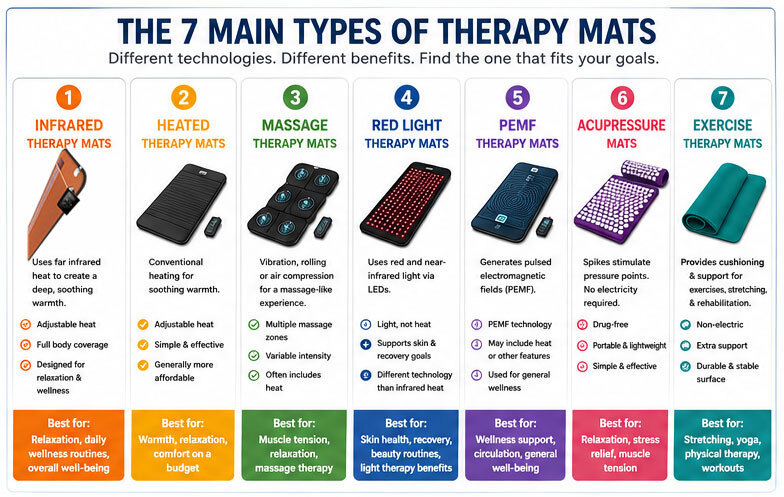
The Seven Main Types of Therapy Mats
Although hundreds of products are marketed as therapy mats, almost all of them fit into one of seven major categories.
Understanding these categories is the first step toward choosing the right one.
1. Infrared Therapy Mats
Infrared therapy mats are among the most recognizable premium therapy mats on the market.
Rather than relying solely on conventional heating elements, these mats are designed to produce far infrared heat. Some models also incorporate natural gemstones or specialized internal construction.
Features often include:
- Adjustable temperature controls
- Padded construction
- Full-body coverage
- Long session capability
- Home wellness use
Infrared therapy mats are commonly chosen by people who want a dedicated wellness routine at home.
2. Heated Therapy Mats
A heated therapy mat uses conventional heating elements to provide warmth. While they share similarities with electric heating pads, they are generally larger and designed for lying down or sitting.
They are often selected by people who simply enjoy warmth and relaxation without the additional technologies found in premium infrared products.
They also tend to be less expensive than many infrared therapy mats.
3. Massage Therapy Mats
Massage therapy mats use vibration motors, air compression, rolling massage mechanisms, or a combination of these features to create a massage-like experience.
Rather than focusing on heat alone, these mats are designed to provide mechanical stimulation.
Many include:
- Multiple massage zones
- Variable intensity settings
- Optional heat
- Remote controls
- Automatic shutoff timers
Massage mats are often used on beds, sofas, or reclining chairs.
4. Red Light Therapy Mats
Red light therapy mats have become increasingly popular in recent years.
Instead of generating heat as their primary function, they contain arrays of LEDs that emit specific wavelengths of red and near-infrared light.
These products differ significantly from infrared therapy mats, even though the names sound similar.
The terms infrared therapy mat and red light therapy mat are frequently confused by shoppers, making this one of the most misunderstood areas of the therapy mat market.
5. PEMF Therapy Mats
PEMF stands for Pulsed Electromagnetic Field.
PEMF therapy mats generate pulsed electromagnetic fields rather than relying primarily on heat or massage.
Some premium wellness mats combine PEMF with other technologies, while others focus exclusively on PEMF.
Because PEMF operates differently than infrared heating or massage, shoppers should understand exactly what technology a particular mat uses before purchasing.
6. Acupressure Mats
Acupressure mats are instantly recognizable because of the hundreds or even thousands of small plastic stimulation points covering the surface.
Unlike heated or infrared therapy mats, acupressure mats require no electricity.
The experience comes from body weight pressing against the stimulation points.
They are among the least expensive therapy mats available.
7. Physical Therapy & Exercise Mats
Not every therapy mat contains electronics.
Many physical therapists recommend thick exercise mats that provide cushioning for stretching, mobility work, rehabilitation exercises, balance training, or floor exercises.
Although these mats may look simple, they serve an entirely different purpose than infrared, massage, or heated therapy mats.
Their primary job is to provide a stable, comfortable surface for movement.
Therapy Mat Comparison Chart
| Type | Primary Purpose | Uses Electricity? | Heat? | Portable? |
|---|---|---|---|---|
| Infrared Therapy Mat | Heat & relaxation | Yes | Yes | Usually |
| Heated Therapy Mat | Warmth | Yes | Yes | Usually |
| Massage Therapy Mat | Mechanical massage | Yes | Sometimes | Usually |
| Red Light Therapy Mat | Light therapy | Yes | Minimal | Varies |
| PEMF Therapy Mat | Electromagnetic technology | Yes | Sometimes | Varies |
| Acupressure Mat | Pressure stimulation | No | No | Excellent |
| Exercise Therapy Mat | Stretching & rehabilitation | No | No | Excellent |
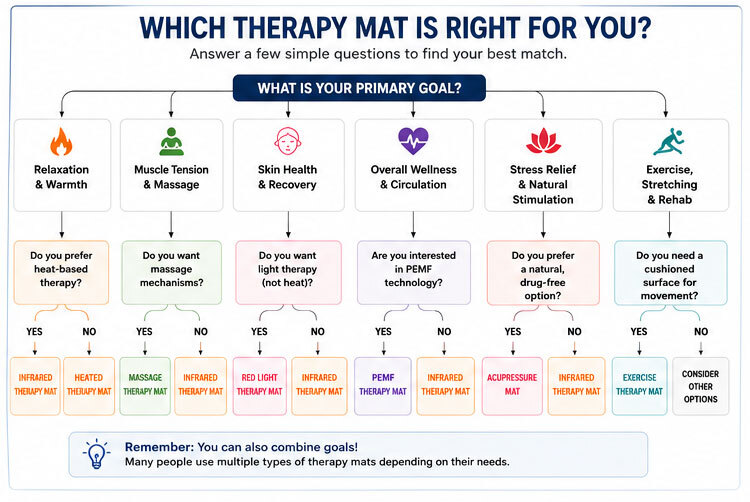
How Do You Know Which Therapy Mat Is Right for You?
One of the biggest mistakes shoppers make is comparing therapy mats based only on price.
A $40 acupressure mat and a premium infrared therapy mat may both be called "therapy mats," but they are designed to provide entirely different experiences.
Instead of asking, "Which therapy mat is the best?" ask a better question:
"What do I want my therapy mat to do?"
That simple shift in thinking makes the buying process much easier.
For example, someone looking for a comfortable surface for daily stretching probably doesn't need a massage mat. Likewise, someone specifically interested in heat-based relaxation may not benefit from purchasing a basic foam exercise mat.
Understanding your goals first—and the technology second—is the key to narrowing your options.
Common Reasons People Buy a Therapy Mat
People purchase therapy mats for many different reasons. Some are building a dedicated wellness space at home, while others simply want a more comfortable place to stretch after work.
Common reasons include:
- Creating a daily relaxation routine
- Enjoying gentle warmth while resting
- Stretching more comfortably
- Supporting post-workout recovery routines
- Meditation or mindfulness sessions
- Floor exercises
- Reading or watching television while relaxing
- Adding a wellness-focused space to the home
The more clearly you understand how you plan to use a therapy mat, the easier it becomes to choose the category that best fits your lifestyle.
Not All Therapy Mats Are Built the Same
Two therapy mats may look nearly identical in photographs while being dramatically different in construction, materials, technology, durability, warranty, and intended use.
That is why experienced buyers often spend as much time researching the manufacturer as they do comparing product specifications.
Beyond size and appearance, factors such as internal construction, quality control, available customer support, warranty coverage, and company reputation can play an important role in the long-term ownership experience.
In Part 2 of this guide, we'll look at how to evaluate those differences, compare therapy mats to other wellness products, explain why prices vary so dramatically, and help you decide which type of therapy mat may best fit your goals.
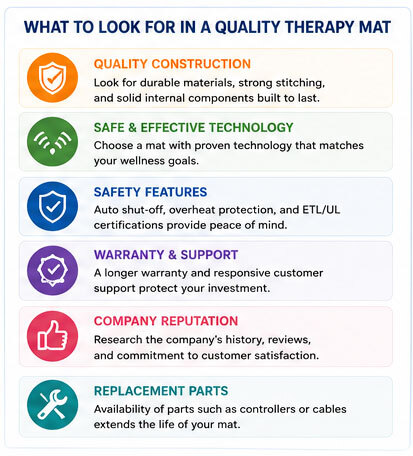
What Makes a High-Quality Therapy Mat?
Once you've decided which type of therapy mat best fits your goals, the next question becomes much more important:
How do you tell the difference between a quality therapy mat and one that simply has good marketing?
This is where many shoppers get overwhelmed. Two products may look nearly identical in photographs while having dramatically different construction, materials, warranties, safety features, and expected lifespans.
Instead of focusing only on price, evaluate the following factors.
Construction Quality
A therapy mat is something you'll likely use repeatedly over many years. Construction quality matters.
Look at:
- Overall thickness
- Padding quality
- Exterior materials
- Internal construction
- Durability of zippers, seams, and stitching
- Controller quality (if applicable)
Better-built products generally feel more substantial and are designed for long-term ownership rather than occasional use.
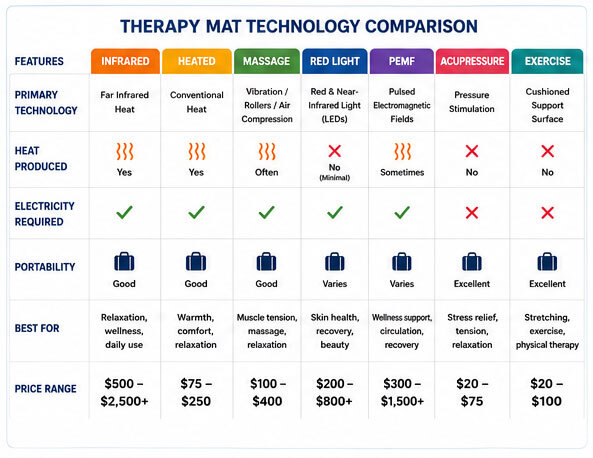
Technology Used
Many buyers unknowingly compare products using completely different technologies.
For example:
- A heated therapy mat produces conventional heat.
- An infrared therapy mat is designed around far infrared heat.
- A massage mat relies on mechanical vibration or rollers.
- A red light therapy mat uses LED light.
- A PEMF mat generates pulsed electromagnetic fields.
Understanding which technology you're actually purchasing is often more important than comparing brand names.
Warranty & Customer Support
One question many shoppers forget to ask is:
What happens if something goes wrong?
Therapy mats with electronic components are more complex than ordinary exercise mats.
Before buying, consider:
- Length of the warranty
- Availability of replacement parts
- Manufacturer support
- Authorized dealer network
- Repair options
Long-term support can be just as valuable as the product itself.
Company Reputation
Some companies have been manufacturing wellness products for decades.
Others appear and disappear within a few years.
Researching the company behind a therapy mat can provide valuable insight into:
- Customer service
- Replacement part availability
- Product consistency
- Long-term support
- Overall ownership experience
Why Do Therapy Mats Cost Anywhere From $30 to Over $2,000?
This is one of the most common questions shoppers ask.
The answer is simple:
Because "therapy mat" describes an entire category—not a single product.
A basic foam therapy mat and a premium infrared therapy mat share very little beyond the word "mat."
| Price Range | Typical Product |
|---|---|
| $20–$75 | Exercise or acupressure mats |
| $75–$250 | Heated therapy mats |
| $100–$400 | Massage therapy mats |
| $200–$800+ | Red light therapy mats |
| $500–$2,500+ | Premium infrared and specialty wellness mats |
Rather than asking why one therapy mat costs more than another, ask what technology, construction, warranty, and support account for the difference.
Therapy Mat vs. Heating Pad
This is one of the most searched comparisons online.
Although both provide warmth, they serve different purposes.
| Heating Pad | Therapy Mat |
|---|---|
| Small coverage area | Often full-body coverage |
| Usually localized heat | Designed for larger treatment area |
| Typically inexpensive | Available in many categories and price ranges |
| Simple design | May include additional technologies |
A heating pad is excellent for localized warmth.
A therapy mat is designed to provide a broader experience that may include heat, massage, light therapy, PEMF technology, or simply a comfortable surface for relaxation and movement.
Therapy Mat vs. Massage Chair
Massage chairs are designed around mechanical massage.
Therapy mats generally focus on flexibility, portability, and versatility.
A massage chair occupies a permanent space within the home.
Many therapy mats can be rolled up and stored when not in use.
Neither is inherently better—they simply serve different purposes.
Therapy Mat vs. Sauna Blanket
Sauna blankets have become increasingly popular as home wellness products.
While both products may incorporate heat, their experiences differ considerably.
A sauna blanket wraps around the body.
Many therapy mats are designed for lying comfortably on top of the surface.
Some people prefer one approach over the other based entirely on comfort and convenience.
Therapy Mat vs. Red Light Therapy
This comparison causes considerable confusion.
A red light therapy mat and an infrared therapy mat are not interchangeable products.
Although both fall within the broader wellness category, they use different technologies and create different user experiences.
Understanding those differences is far more valuable than assuming one replaces the other.
Should You Buy the Cheapest Therapy Mat?
Not necessarily.
Likewise, the most expensive therapy mat is not automatically the best choice.
The goal should always be finding the product that best matches your intended use.
Someone looking for a comfortable stretching surface may have no need for an advanced infrared therapy mat.
Conversely, someone specifically seeking a premium far infrared therapy mat may quickly outgrow an inexpensive heated pad.
The "best" therapy mat is the one that aligns with your goals—not simply your budget.
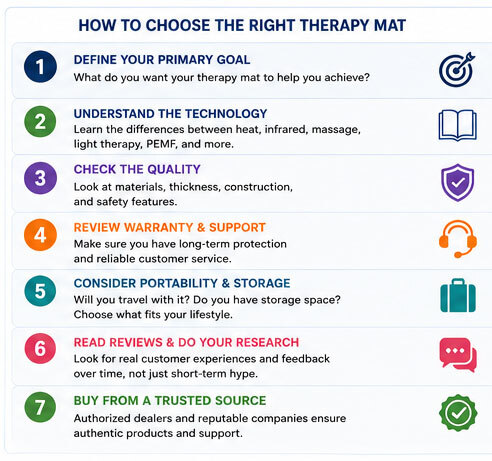
Choosing the Right Therapy Mat for Your Lifestyle
Consider asking yourself these questions before purchasing.
- Will I use it daily or occasionally?
- Do I want heat?
- Do I want massage?
- Will I travel with it?
- Will multiple family members use it?
- Do I want something portable?
- How much space do I have?
- Am I looking for relaxation, stretching, exercise, or another type of wellness experience?
Your answers will narrow the choices considerably.
Where Does the Richway Biomat® Fit Into the Therapy Mat Market?
By now, you've probably realized that "therapy mat" is an umbrella term covering many different types of products.
The Richway Biomat falls within the category of premium far infrared therapy mats.
Unlike massage mats, heated blankets, or basic exercise mats, it is designed around far infrared technology and premium construction for people seeking a dedicated home wellness product.
That doesn't make it the right choice for every shopper.
Someone looking for a $40 exercise mat should buy an exercise mat.
Someone looking for vibration massage should buy a massage mat.
Someone specifically interested in a premium far infrared therapy mat should compare products within that category instead of comparing completely different technologies.
Understanding the category first makes every buying decision easier.
Frequently Asked Questions About Therapy Mats
What is a therapy mat?
A therapy mat is a general term for mats designed to support relaxation, stretching, recovery, heat therapy, massage, or other wellness activities. Different therapy mats use different technologies depending on their intended purpose.
What is the best therapy mat?
The best therapy mat depends entirely on your goals. Exercise mats, massage mats, infrared therapy mats, heated mats, and acupressure mats are designed for different uses.
Are therapy mats worth buying?
Many people find value in a therapy mat that matches their intended use. Choosing the correct category is more important than simply buying the most expensive model.
What's the difference between a therapy mat and a heating pad?
A heating pad provides localized warmth. Therapy mats are generally larger and may incorporate heat, massage, infrared technology, PEMF, red light therapy, or simply provide a comfortable exercise surface.
Can I use a therapy mat every day?
Many therapy mats are designed for regular home use. Always follow the manufacturer's operating instructions, recommendations, and any safety information provided with your specific product.
Final Thoughts
The phrase "therapy mat" covers an incredibly wide range of products.
That's why choosing one can initially seem confusing.
The key is understanding that there isn't one perfect therapy mat—only the one that best fits your goals.
Whether you're looking for a simple exercise mat, a massage mat, a heated therapy mat, or a premium far infrared therapy mat, understanding the differences between the categories will help you make a more informed decision.
Take time to identify how you plan to use the mat, research the company behind it, compare warranties and construction quality, and choose the product that best supports your long-term wellness routine.
An informed purchase is almost always a better purchase.