

Posted by Biomatstores.com on 6th Jun 2026
What Happens When You Stop Sleeping Well for 10 Years?
One bad night of sleep is annoying. One bad week can make you feel foggy, irritable, and off your game.
But what happens when poor sleep does not last for one night, one week, or one stressful season?
What happens when it quietly becomes your normal for ten years?
Most people do not wake up one morning and suddenly realize their body has been running on empty for a decade. It usually happens slowly. You get used to feeling tired. You get used to needing more caffeine. You get used to lower patience, weaker focus, slower recovery, and the sense that you are not quite the person you used to be.
That is the danger of long-term poor sleep. It does not always feel dramatic while it is happening. It feels like life.
The Problem Is Not One Bad Night. It Is the Stack.
Sleep debt is the gap between the sleep your body needs and the sleep you actually get. If your body needs eight hours and you get six, that missing time does not simply disappear. Over time, the deficit can build.
A few short nights may be manageable. But years of short, fragmented, or inconsistent sleep can start affecting the way you think, feel, recover, and function.
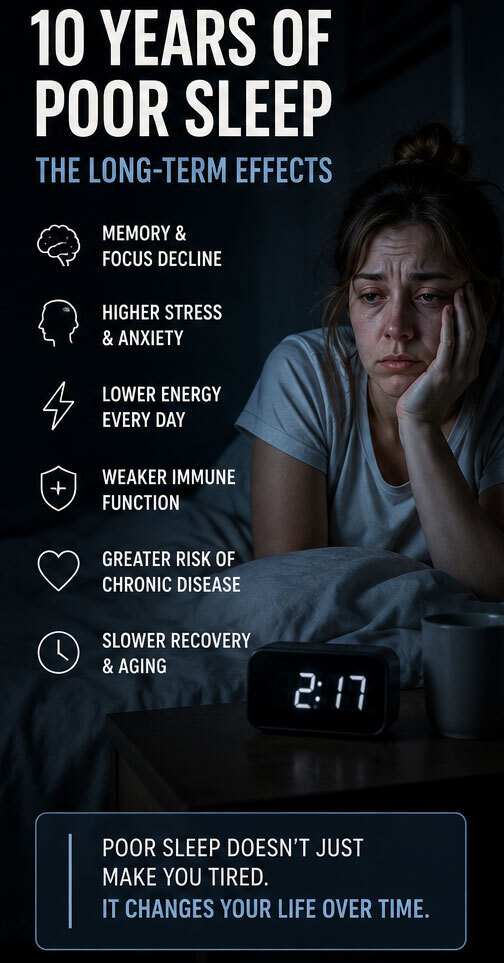
According to the CDC, insufficient sleep is associated with increased risk for several chronic conditions, including obesity, diabetes, hypertension, heart disease, stroke, anxiety, and depression. Sleep loss can also contribute to accidents and errors because of its effect on alertness and reaction time.
That does not mean every tired person is headed for disaster. It means sleep is not optional maintenance. It is one of the systems your body uses to regulate nearly everything else.
Year After Year, Poor Sleep Changes What “Normal” Feels Like
The most unsettling thing about chronic poor sleep is how easy it is to normalize.
You may not describe yourself as sleep deprived. You may just say:
- I am not a morning person.
- I need coffee before I can function.
- I cannot focus like I used to.
- I am always tense.
- I do not recover like I used to.
- I feel older than I should.
- I am tired even when I technically slept.
Over ten years, those small changes can become part of your identity. But they may not be personality traits. They may be signals that your body has not been getting enough consistent recovery.
Your Brain Pays Attention First
Sleep is deeply connected to memory, focus, learning, and decision-making. Harvard’s Division of Sleep Medicine notes that inadequate sleep can affect the brain’s ability to consolidate both factual information and procedural memories.
That matters because poor sleep does not just make you tired. It can change the quality of your thinking.
You may notice:
- More mental fog
- Slower recall
- Less patience
- More mistakes
- Reduced creativity
- Difficulty finishing tasks
- More emotional reactivity
This is one reason long-term sleep loss is so frustrating. You may still be functioning, but you are functioning with less margin.
Your Stress System Stops Getting a Full Reset
Sleep helps the body regulate stress. When sleep is poor, the nervous system may spend more time in a heightened state. Over time, that can make normal life feel harder than it should.
This is where many people get stuck.
Poor sleep increases stress. Stress makes sleep harder. Then worse sleep makes the next day feel more stressful. The cycle feeds itself.
After years of this, some people do not feel obviously “stressed.” They feel wired, tense, restless, easily irritated, or unable to fully relax.
Your Body May Recover More Slowly
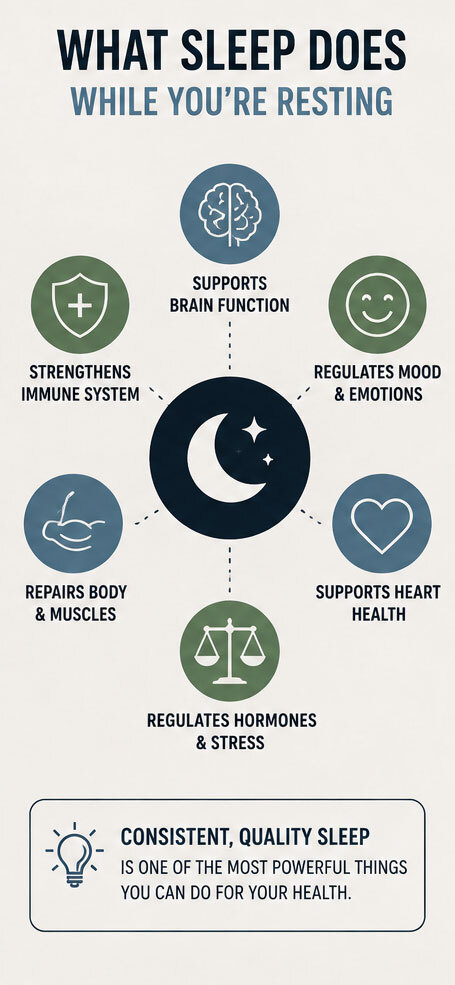
Sleep is one of the body’s major recovery windows. It is involved in tissue repair, immune regulation, hormone rhythms, and energy restoration.
When sleep is consistently poor, people often notice recovery feels different.
- Workouts feel harder to bounce back from.
- Minor aches feel more noticeable.
- Energy feels less predictable.
- Motivation drops.
- Rest days do not always feel restorative.
This is why sleep should not be treated as separate from wellness. It is the foundation underneath many wellness goals.
You May Start Buying Solutions for the Wrong Problem
This is where the wellness industry gets complicated.
When people feel tired, foggy, stiff, moody, or worn down, they often start buying solutions:
- More supplements
- More caffeine
- More productivity tools
- More fitness programs
- More tracking devices
- More recovery gadgets
- More biohacking products
Some of those tools may be useful. But if poor sleep is still the foundation, everything else has to work harder.
Before adding another complicated wellness product, it may be worth asking a simpler question:
Am I giving my body enough consistent recovery to make anything else work well?
Why Sleep Problems Are Often Routine Problems
Not every sleep issue is solved by better habits. Sleep apnea, chronic insomnia, medication effects, pain, anxiety, and medical conditions should be discussed with a qualified healthcare professional.
But for many people, poor sleep is also connected to the hours before bed.
Evening routines can train the body either toward alertness or toward rest.
Common sleep-disrupting patterns include:
- Late screen exposure
- Working until the moment you lie down
- Heavy late meals
- Too much evening caffeine or alcohol
- Inconsistent bedtimes
- No real transition between stress and sleep
- A bedroom environment that does not feel calming
The goal is not perfection. The goal is creating a repeatable signal that the day is ending.
The Most Underrated Sleep Strategy: Learning How to Wind Down
Many people focus only on the moment they get into bed. But better sleep often begins earlier.
A strong wind-down routine may include:
- Dimming lights
- Reducing screens
- Reading instead of scrolling
- Gentle stretching
- Breathing exercises
- A warm bath or shower
- Quiet music
- A consistent bedtime window
- Creating a comfortable sleep environment
This is not about forcing sleep. It is about helping the body shift out of performance mode.
Why Warmth Has Always Been Part of Relaxation
Across cultures and generations, people have used warmth as part of evening comfort rituals. Warm baths, saunas, heated stones, warm compresses, and cozy bedding all speak to something simple and familiar.
Warmth helps people slow down.
That is one reason heat-based wellness has lasted while countless wellness trends have disappeared. It is not complicated. It fits real life. It feels intuitive.
Modern far infrared wellness products build on that same basic idea using radiant warmth designed for comfort-focused routines.
Where Far Infrared Wellness Fits Into the Conversation
Far infrared wellness products are not a cure for sleep problems, and they should not be treated as a replacement for medical care when sleep issues are persistent, severe, or connected to a health condition.
But for people building a more intentional evening routine, comfort-focused heat can be part of the environment that helps them slow down.
The Biomat is FDA-cleared for the temporary relief of minor muscle and joint pain, stiffness, minor joint pain associated with arthritis, muscle spasms, and temporary increase in local circulation where applied.
For many people, the value is not just in the technology itself. It is in the routine it supports: lying down, disconnecting, relaxing, and giving the body a consistent signal that the day is over.
The Real Cost of 10 Years of Poor Sleep
The real cost of poor sleep is not just feeling tired.
It is the slow erosion of capacity.
Less patience. Less focus. Less recovery. Less resilience. Less ability to feel fully restored.
Poor sleep does not always steal your health overnight. Sometimes it steals your edge slowly enough that you forget what rested used to feel like.
So What Should You Do?
Start with the basics.
- Keep a consistent sleep and wake schedule when possible.
- Create a calming pre-bed routine.
- Limit bright light and screens before bed.
- Avoid late caffeine.
- Make your bedroom cool, dark, and quiet.
- Use warmth, stretching, or relaxation rituals to transition into rest.
- Talk to a healthcare professional if sleep problems persist or feel severe.
You do not need a perfect routine. You need one you can repeat.
The Bottom Line
One bad night of sleep is part of life.
Ten years of poor sleep is different.
That kind of sleep debt can quietly shape your energy, mood, focus, recovery, and relationship with your own body.
The good news is that sleep routines can be rebuilt. Not through panic. Not through gimmicks. Through consistent signals, better habits, a calmer evening environment, and wellness tools that support routines people actually stick with.
If your body has spent years running on empty, the most powerful change may not be adding more intensity to your life.
It may be learning how to recover again.
Explore Biomat® Far Infrared Wellness Products